Back to work
Case Study Web Design UI/UX FinTech

Pymatuning

A white label FinTech platform selling complex B2B infrastructure: digital wallets, branded payment cards, 10M+ transactions, needed to compress their entire value proposition into a single confident scroll.

pymatuning.com
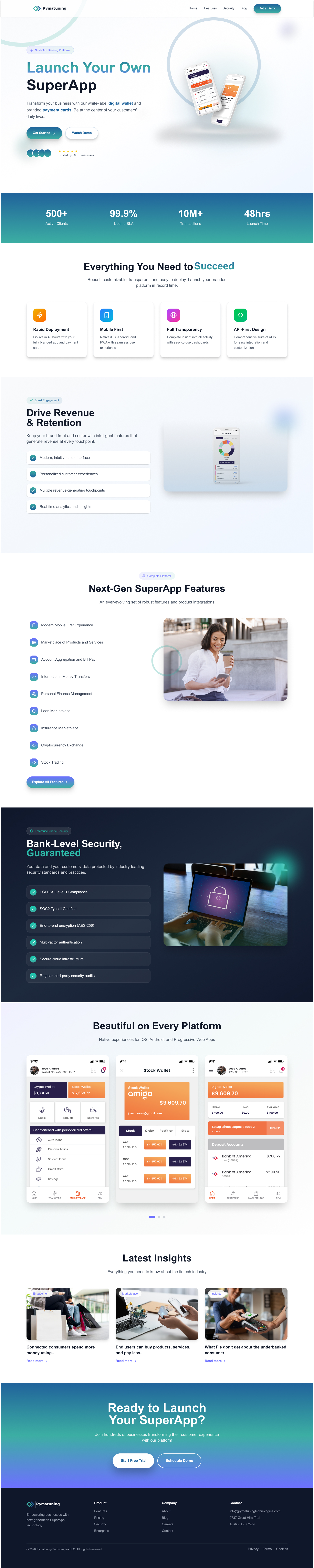
Pymatuning website, desktop view

Role

Web Designer

UI Design · UX · Development

Timeline

4 Weeks

Concept through delivery

Scope

Marketing website

Design · Build · Launch

Tools

Figma

HTML · CSS · JavaScript

The Challenge

Pymatuning sells B2B FinTech infrastructure, which means persuading CTOs and business owners to trust them with money movement, regulatory compliance, and customer-facing financial products. The product is powerful but technically complex. The website needed to sell the outcome, not the architecture.

The Gap

FinTech platforms often fall into one of two traps: overwhelming technical documentation that only engineers appreciate, or vague marketing copy that says 'powerful' and 'scalable' without saying anything. Neither closes deals with CTOs who need to justify vendor selection to a board.

The Brief

Compress a complex B2B FinTech value proposition into a single confident scroll. Lead with proof of scale, structure features as business outcomes, and give enterprise buyers the security credentials they need to advance the conversation internally.

Pymatuning platform full view

Research & Discovery

Competitive Analysis

I reviewed four established players in the B2B payments and FinTech infrastructure space to understand how they balance technical depth with business-level persuasion.

Stripe

The gold standard for developer-led fintech marketing: technical depth with clean design. But Stripe's mass-market pricing and developer-first narrative don't speak to mid-market B2B buyers who need white-label infrastructure and relationship support.

Plaid

Strong data connectivity positioning and institutional credibility. The website speaks competently to bank integrations and compliance, but the enterprise value proposition requires a demo call before the full picture emerges.

Checkout.com

Premium brand with global payment focus. The site communicates scale effectively but is structured around retail and marketplace payments. B2B white-label infrastructure sits in the margins, not the hero.

Generic WaaS Providers

Wallet-as-a-Service players that lead with feature lists instead of outcomes. Security credentials buried in FAQs. The buying process feels like assembling a product, not partnering with an infrastructure provider.

Criteria Stripe Plaid Checkout.com Pymatuning
Leads with outcomes Partial Partial No Yes
Security creds visible Yes Yes Yes Yes
B2B white-label focus No Partial No Primary

Design

Complex product. Simple story.

pymatuning.com
Pymatuning desktop
Pymatuning mobile

Credibility Numbers First

Scale, reliability, transaction volume, launch speed: four B2B buyer objections mapped to four proof points, each positioned above the feature section so trust is established before persuasion begins.

Outcome-Framed Features

Features like "Loan Marketplace," "Crypto Exchange," and "International Money Transfer" listed under "Drive Revenue & Retention," reframing product capabilities as business value instead of technical specs.

Security Certifications

PCI DSS Level 1, SOC2 Type II, end to end AES-256 encryption, multi factor authentication, listed in a dark "Bank-Level Security" section timed to appear exactly when enterprise skepticism peaks during the scroll.

Process

How it came together

01

B2B Value Mapping

Translating technical product features into business outcomes. Every feature section restructured around a revenue driver, a retention mechanism, or a compliance concern, the language of the buyer, not the engineer.

02

Feature Architecture

Grouping 10+ product features into four scannable sections: Revenue & Retention, Next-Gen Features, Security, Platform. Each section designed to answer a different buyer concern at the right moment in the scroll.

03

Trust Calibration

Numbers above the hero. Certifications in the security section. App screenshots demonstrating production quality. Blog articles establishing domain authority. Every trust signal placed where objections arise, not where they're convenient.

04

Platform Showcase

Real iOS, Android, and web app screenshots in the "Beautiful on Every Platform" section, the product visible at production fidelity. No mockups. No empty frames. The actual UI as the final argument to act.

Results

Impact

Scale first

Client's largest credibility number positioned above the fold as the opening argument to every B2B visitor, before any feature is described

Volume proof

Transaction history surfaced to signal enterprise-grade reliability to B2B decision-makers before any feature explanation begins

Speed first

The client's fastest launch promise positioned as the decisive stat for B2B buyers weighing build vs buy decisions

Pymatuning now has a website that earns trust from the first scroll and sustains it through every feature section. Complex FinTech infrastructure becomes a simple decision. The design compresses the full value proposition into a single confident scroll, structured so every section resolves a B2B buyer objection before it forms.

Senyu Fine Dining website, desktop view

Next project

Senyu Fine Dining →

Web Design · Development · F&B

